
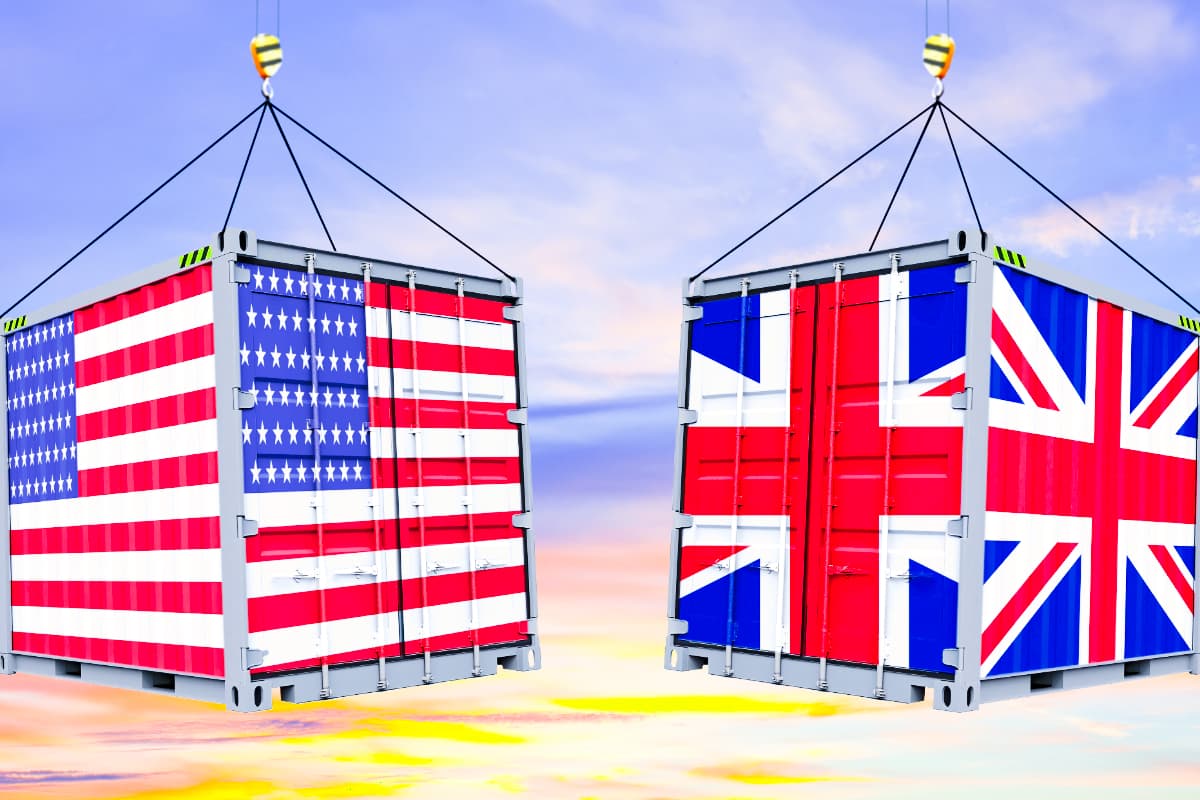
When the United Kingdom voted to leave the European Union in 2016, many of its proponents believed that it was a bold reassertion of British sovereignty – a reclaiming of control over borders, laws, and trade from the EU. While the debate on Brexit continued until the official exit from the European Union in 2020, populists such as Nigel Farage and Boris Johnson claimed victory in the meantime. Nearly a decade later – the results could not be more contrary to their vision: stagnant growth, sluggish investment, higher import costs, and an economy that consistently lags its peers who remained in the EU. We view the Trump tariffs as a similar situation – and the United States risks the same fate as our British counterparts.
The tariff regime currently imposed by the second Trump administration places sweeping new taxes in the name of domestic revival, being sold with the same rhetoric as Brexit: revitalization of American manufacturing, punish bad trading actors, and liberation from the rest of the world. However, the deeper cost of economic nationalism may not be immediately obvious. The true damage lies far below the surface.
Firstly, we need to set the record straight on tariffs. Simply put: tariffs are not a growth policy . They are a consumption tax – one that will hit producers and working families hard. While consumption taxes are common – think of sales taxes at the state level, or federal value-added taxes (VATs) in Europe – tariffs are designed to discourage the consumption of a certain good. In this case, it is designed to discourage imports to make domestically produced goods more competitive. On its face, this seems like a good policy. What proponents of tariffs fail to consider are the inefficiencies this introduces to markets. Firstly, taxes introduce deadweight loss through artificially raising the equilibrium price in markets. Tariffs are taxes, so this shouldn’t be a shock. However, this is very surface level: we’re only considering the market distortions taxes bring on one good. What is far more important, in our view, is the second order effect tariffs bring. Tariffs will raise the cost of inputs for all producers who may rely on foreign materials. This was exposed during the COVID pandemic and its aftermath – supply chain disruptions greatly raised prices of inputs, which resulted in supply shortages and inflation. Tariffs will take this from a momentary blip in time to being systemically enforced – all producers must accept the cost of higher inputs. American manufacturing excels at high level, final production items. This will benefit domestic raw materials manufacturers – but everyone who makes things from raw materials will suffer. This is the majority of American manufacturers. Major domestic manufacturers use imported materials to create electronics, machinery, aircraft etc. Even from a strictly protectionist point of view, this is undesirable.
Firstly, we need to set the record straight on tariffs.
Now, let’s pivot back to Brexit. What did Brexit actually do? In economic terms, it pulled the UK out of the European Single Market and Customs Union and suspended free movement of persons between the UK and the EU. This came into effect in January 2020, with the terms of the new EU-UK relationship being announced in December 2020. The agreement included no tariffs and quotas on goods, with no preferential treatment to domestic services over EU services. However, there is no longer access to other nation’s general services markets. For example, financial institutions can no longer access EU clients through passporting practices. Finally, there is more restriction on the movement of persons, now requiring visas for EU citizens. On the face of it – this does not seem quite bad, given the discussion about the negative effects of tariffs. However, what should be highlighted is the idea that the true cost of economic nationalism is not just economic, but relational. Brexit fundamentally broke the EU-UK relationship only for the UK to crawl back to that relationship on less favorable terms than before. Brexiteers sold Brexit on the idea that the UK could recreate the EU-UK relationship in the aggregate via trade deals with the United States and the CANZUK nations (Canada, Australia, New Zealand). These deals never materialized, as the UK already has favorable trade relations with these nations and does not have the leverage to extract more from them (Estrin, et al. 2018). In fact, Brexit destroyed the UK’s reputation on a global stage in addition to the financial stage.
Prior to the ratification of Brexit in 2019, it was reported that British firms were offshoring more – not less – to the European Union than pre-2016 (Sampson, et al. 2019). Furthermore, the threat of Brexit caused uncertainty for many investors, with studies finding uncertainty induced by Brexit reduced GDP, national income, investment by business, employment, and international trade from 2016 onwards (Crowley & Exter, 2019). While the actual ratification of Brexit may not have produced a horrible situation, the true damage Brexit caused was the undermining of the British system as a whole. We can see this reflected in the financial markets surrounding the UK. Firstly, the Pound has sat at all-time lows relative to the Euro and the Dollar since the 2016 referendum.
GBP/EUR data and GBP/USD data sourced from Yahoo Finance
GBP/EUR data and GBP/USD data sourced from Yahoo Finance...
While a weaker currency typically helps domestic industry export to other nations, real GDP from manufacturing has since gone flat.
UK Manufacturing GDP data sourced from Trading Economics
In addition, exports to European Union nations (in this case, Germany) have declined.
In addition, exports to European Union nations (in this case, Germany) have declined.
UK Exports to Germany data sourced from Trading Economics
Similarly, foreign direct investment has been on a downward trend over the last ten years. Overall, the UK has hovered around zero net foreign direct investment, showing that money is not moving into the country.
UK Foreign Direct Investment data sourced from Trading Economics
UK Foreign Direct Investment data sourced from Trading Economics...
Furthermore, the UK increased imports from China to supplement the decreased trade from the EU. The idea of greater independence from the rest of the world ultimately materialized as a weaker position internationally. The best way to illustrate this is comparing the FTSE 100 (the UK’s equivalent to the S&P 500 stock index) to the EWU ETF (The United Kingdom stock ETF which trades on US exchanges in US dollars).
FTSE 100 data & EWU data sourced from Yahoo Finance
Zooming out, the FTSE 100 has eclipsed its pre-2008 peak. However, EWU has yet to even come close to its previous peak in nominal terms. To put it in more “real terms”, we can see that EWU has underperformed the FTSE 100 in cumulative terms, especially since 2020. The FTSE 100 has delivered 10-20% cumulative returns in pounds, but negative dollar returns since the beginning of 2008.
Zooming out, the FTSE 100 has eclipsed its pre-2008 peak.
This indicates that currency weakening vs the dollar and other reserve currencies has destroyed the value of UK companies across the world – something that will remain until the UK does something to reverse course. This has all come alongside a cost-of-living crisis that outpaces the one we see in the US. UK inflation peaked in 2022 at around 11%, outpacing the US inflation rate of around 8.5%. Nominally, we can see UK home prices have surged over time.
UK Home Price data sourced from UK Land Registry
However, when we put home prices in USD and Euro terms, we see a less favorable picture.
However, when we put home prices in USD and Euro terms, we see a less favorable picture.
UK Real Estate cratered in USD terms and has only now recovered to its previous 2008 peak in nominal terms. Euro-denominated investors have seen a real return, but when we break things into the real, deflated dollar value, we see a very bleak picture.
What we can see is that since 2008, real estate in the UK has gained 0-dollar value in real terms. While Brexit itself may not have been a cause of this, what we can deduce from our previous points about GDP growth, the strength of the pound, and inflation is that life in the UK has become more expensive with no real wealth being built in that time.
What we are ultimately trying to communicate by highlighting Brexit is what real damage can be done by severing relationships across the world. Many would hold that the tariffs are Trump’s way of trying to exercise leverage on the global system. What Brexit shows us is that this is ultimately a fool’s errand – trying to leverage the rest of the world by holding your own economy hostage does not put your country in a better position. Rather, it makes the situation worse. It is trying to get back at misgivings from trade partners by threatening to blow up the bridge connecting the two of you – only for the other party to just go somewhere else and leave you reliant on others. In this way, we can see that the systems themselves are collectively undermined beyond the economic impact of potential stagnation and inflation. The US is threatening to do this to itself – destroying relationships only to realize it needs relationships with the rest of the world to function. Ultimately, these relationships will be dictated in less favorable terms than before. What Brexit can show is that this way of negotiating on the global stage results in a stagnant economy, weakened purchasing power, and less self-sufficiency than before.
What we are ultimately trying to communicate by highlighting Brexit is what real damage can be done by severing relationships across the world.
References
Sampson, T., Leromain, E., Novy, D., & Breinlich, H. (2019, February 12). Voting with their money: Brexit and outward investment by UK Firms | CEPR . CEPR. https://cepr.org/voxeu/columns/voting-their-money-brexit-and-outward-investment-uk-firms
Crowley, M., Exton, O., Han, L. (21 January 2019). The impact of Brexit uncertainty on UK exports | VoxEU . CEPR. https://cepr.org/voxeu/columns/impact-brexit-uncertainty-uk-exports
The impact of Brexit uncertainty on UK exports | VoxEU .
Estrin, S., Cote, C., Shapiro, D. (21 August 2018) . Long read: Can Brexit defy gravity? It is still much cheaper to trade with neighbouring countries. | LSE Blog. London School of Economics.
Disclosures:
Williams Wealth Management is a member of Advisory Services Network, LLC
Williams Wealth Management is a member of Advisory Services Network, LLC...
All Information contained herein is derived from sources deemed to be reliable but cannot be guaranteed. All economic and performance data is historical and not indicative of future results. All views/opinions expressed in this newsletter are solely those of the author and do not reflect the views/opinions held by Advisory Services Network, LLC.
Our team is always happy to explore how these ideas apply to your personal financial situation.
Schedule a ConversationJeremy Strickler, CFP®jeremy@wwmgreenville.com “See to it that no one fails to obtain the grace of God; that no root of bitterness springs up and causes trouble, and by it many become defiled; 16 that no one is … unholy like Esau, who sold his birthright for a single meal. 17 For you know that afterward, when he desired to inherit the […]
By Jeremy Strickler
The Federal Reserve hits pause & an AI upstart may have upended some common beliefs among investors. How all of it may affect your money. Watch this week’s segment of Mike on the Money on WYFF News 4.
By Mike Giordano
Laying out the investment landscape in 2025. How to think about positioning your money. We’ll offer insights in this week’s segment of Mike on the Money on WYFF News 4.
By Mike Giordano