
If you follow only stocks, you’d see the market taking a little breather over the past month, with the major indices down about 2%. Stocks seem pretty calm, with the story of AI boosting corporate profits– in the future– somewhat balanced against a blah short-term growth outlook.
The equity markets seem to trust the economy and the fed and to be looking past the interest rate hiking cycle to better days ahead.
However, there is a lot of drama in the markets– in credit. Over the past 4 months, the 10 year US treasury yield has moved up almost a full 1%, with the 30 year yield up over 1/2%.
However, there is a lot of drama in the markets– in credit.
Source : Koyfin
Real World Impact
This is a huge move in long term interest rates that has sent 30-year mortgages to the highest rates since 2000! (Bloomberg). When you stack higher home prices on top of higher interest rates, we get housing that’s not affordable, relative to the average income. This is not a good input into the economy.
This is a huge move in long term interest rates that has sent 30-year mortgages to the highest rates since 2000!
One of the sneaky advantages we had coming out of the 2008-2009 financial crisis was that the US had overbuilt in the housing market, and houses were the most affordable they had been (on average) with new purchases averaging just over 10% of incomes.
Now, people are debating (again) whether it’s ok to tie up 35 or 40% of your income with your home purchase. Here’s a hint: NO! don’t do that unless you stand to make a lot more money really soon. This is a bad idea. You have no margin for error that way. You have a new house with no money to put into maintaining it, no cash flow for other wants and needs, and you have financial stress.
And that’s how the public is voting with home purchase applications, the lowest they’ve been since 1995.
And that’s how the public is voting with home purchase applications, the lowest they’ve been since 1995.
My mortgage rate is 3.75%. Guess what we’re doing? Fixing our house. Guess what we’re not doing? Selling our house.
We are probably going to see the low interest rates of a couple of years ago combining with high rates now to limit social mobility for a bit. There’s not enough inventory.
Corporate Finances
Corporate Finances...
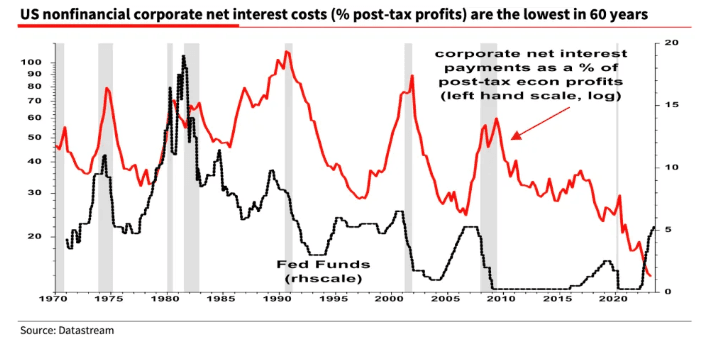
Mike Giordano sent me this chart a few weeks back. What it shows is that in previous recessions (the gray bars), as interest rates were hiked and as the economy weakened, interest payments (the red line) ate up a lot or most of corporate free cash flow .
Historically this usually leads to a selloff in stocks: if we don’t know what earnings are going to be, and if we don’t have a good guess about how earnings will grow, it becomes harder to value companies. So, we get downward pressure on stocks, with lower earnings trading at lower multiples until something breaks the trend. It’s a temporary trend. But if “temporary” is more than a year, that’s a long time in human experience and the market tends to throw in the towel.
Weirdly, this year we’ve seen a rally in (some) stocks, enough to boost the prices of the major indices.
Weirdly, this year we’ve seen a rally in (some) stocks, enough to boost the prices of the major indices.
Why? Because rising interest rates have hardly affected corporate finances to this point. Check out the red line: corporate interest payments as a % of profits have declined even as interest rates rose.
Why haven’t stock prices or real estate prices come down further? We think it hasn’t happened Yet , because it was obvious to us and to people running larger businesses, that we ought to lock in low interest rates for as long as possible.
What we’ve seen in markets this year is that very few companies had to refinance their debt at higher interest rates. Yet. So, higher rates haven’t broadly affected the bottom line.
What we’ve seen in markets this year is that very few companies had to refinance their debt at higher interest rates.
We speculate that will begin to happen next year. Here’s a chart from Goldman Sachs Global Investment Research:
This suggests if interest rates stay higher for much longer, corporations will start to feel the impact on profits, but that there’s a little bit of runway left for the Fed to fight inflation.
How long? Our guess is that we can hold interest rates here for 6-12 months, but not 2-3 years.
Our guess is that we can hold interest rates here for 6-12 months, but not 2-3 years.
Over that longer period of time, a good bit of the outstanding treasury debt would have to be refinanced at higher rates, (around 5%) and higher interest costs would eat into corporate spending on other things like wages and capital expenditures- i.e., investments in the future growth of companies. Here’s a substantial piece from Goldman Sachs on the impact to corporate finances.
Short story: when you pay more interest, you can’t invest or consume as much. That seems to be on the radar in the near future.
Banking
Banking...
The exception to rising rates having little effect is in banking, where quite a number of banks are forced to pay higher interest rates to maintain deposits, and also the value of their loan portfolios have fallen as interest rates rose.
Think about it. A bank lent me money at 3.75% a few years ago, and now many banks are paying over 4% interest just to hang on to deposits.
Fractional reserve banking is not built for short term interest rates to be higher than long term interest rates or for short term rates to rise 5% in one year. So, until that situation resolves, a good number of banks will be less able to lend money, and banks are accumulating problems as time goes on.
Fractional reserve banking is not built for short term interest rates to be higher than long term interest rates or for short term rates to rise 5% in one year.
That’s exactly how rising interest rates have an impact on lowering inflation. People buy less stuff, build less stuff, invest in less stuff, and prices tend to come down. Because money is less available.
China
A third factor arguing that rates may be close to peaking is that China’s economy is slowing due to internal factors (Party control) and external factors like trade sanctions. This could have some drag on the global economy or the US economy in the future. Without speaking too much about things we don’t totally understand it would be desirable for the US and China to iron out their differences to some extent and to go the other direction with the escalating trade war.
A third factor arguing that rates may be close to peaking is that China’s economy is slowing due to internal factors (Party control) and external factors like trade sanctions.
What’s the Point?
The real-world situation is not bad. Growth actually seems to be picking up at the moment. We have a bit over 2% GDP growth this year. However, we’re highlighting some of the risks in the environment over the coming year.
Rising interest rates will probably push down asset prices if interest rates are held above 5%.
Rising interest rates will probably push down asset prices if interest rates are held above 5%.
This may be part of what the Fed needs to see before they turn their focus back towards growth.
Are we selling all our stocks? Not much. There’s a lot to invest in – if you have 2 to 5 years to think about the question.
However, we have the best prices in bonds we’ve had in 15 years.
However, we have the best prices in bonds we’ve had in 15 years.
Could inflation pull rates higher? It could. We are dollar cost averaging money into long term bonds.
If interest rates continue to rise, we expect to increase client allocations to bonds. We think the timing is good enough. We plan to build positions over time instead of guessing about the bottom price.
This could be an attractive source of return if the economy slows. Bonds can appreciate if rates fall.
This could be an attractive source of return if the economy slows.
Bonds could truly diversify stock exposure in the future if rates stabilize or decline.
For the past 18 months, bonds have been a source of risk. Long term bonds have more volatility– they are higher up the risk/ reward curve than they were in the low interest rate environment.
However, ironically — As bond prices fall, the risks are getting lower, and the rewards are going higher.
However, ironically — As bond prices fall, the risks are getting lower, and the rewards are going higher.
This impact could attract some capital away from stocks and real estate until bond prices stabilize and rates go back down again.
A Personal Message
This June marked my 25 th anniversary as a financial advisor. Some of you have been with me nearly the entire time. I can’t tell you what it’s meant to have your trust and often your input into my thoughts and perspectives. A number of clients a generation ahead saw promise in me but also took me under their wing and helped me fit in, understand the culture and have a place in Greenville.
This June marked my 25 th anniversary as a financial advisor.
You’ve stuck with us through changes in where we worked and how we worked. You’ve given us good investment ideas. You supported our work and believed in us. This is everything. Thank you.
Jeremy L. Strickler, CFP®
Portfolio Manager
Portfolio Manager...
All information contained herein is derived from sources deemed to be reliable but cannot be guaranteed. All economic and performance data is historical and not indicative of future results. All views/opinions expressed in this newsletter are solely those of the author and do not reflect the views/opinions held by Advisory Services Network, LLC.
Stocks Companies mentioned are for informational purposes only. It should not be considered a solicitation for the purchase or sale of the securities. Investing involves risks, and investment decisions should be based on your own goals, time horizon, and tolerance for risk. The return and principal value of investments will fluctuate as market conditions change. When sold, investments may be worth more or less than their original cost. Companies may reschedule when they report earnings without notice.
A bond is a fixed-income instrument that represents a loan made by an investor to a borrower (typically corporate or governmental). A bond could be thought of as an I.O.U. between the lender and borrower that includes the details of the loan and its payments. Bonds are used by companies, municipalities, states, and sovereign governments to finance projects and operations. Owners of bonds are debtholders, or creditors, of the issuer.

Written by
Jeremy StricklerManaging Director, CFP®
I grew up south of Pittsburgh in the foothills of the Appalachian mountains. I'm the oldest of 5 children. My parents built their own house and gardened. We did everything ourselves. Independence is a...
Read Jeremy's Story →Our team is always happy to explore how these ideas apply to your personal financial situation.
Schedule a ConversationHow children can use their paychecks to start building their own nest egg, setting them up for financial stability down the road.
By Mike Giordano
Here’s the truth about compound interest: it requires your energy up front.
By Mike Giordano
Getting your finances in order is not a one-time event. It’s a process. Start today by learning how.
By Mike Giordano